


AI Write for us: Artificial intelligence (AI) is a set of skills that enables computers to perform a diversity of complex functions, such as vision, comprehension, translation of oral and written speech, data analysis, and recommendation-making.
AI is at the heart of innovation in modern computing systems, opening new opportunities for people and businesses. For example, optical character recognition (OCR) uses AI to excerpt text and data from images and documents, transforming unstructured content into structured business-ready data and providing valuable analytics.
How does AI work?
While the details of different AI methods vary, the core principle revolves around data. AI systems learn and improve by working with large volumes of data, identifying patterns and relationships that humans may overlook.
This learning process typically involves algorithms: rules or instructions that guide the AI’s analysis and decision-making. In machine learning, a popular subfield of AI, algorithms are trained on labelled or unlabeled data to predict or classify information.
Deep learning, another specialisation, uses multi-layer artificial neural networks to process information, mimicking the structure and function of the human brain. Through continuous learning and adaptation, AI systems are becoming increasingly efficient at performing specific tasks, from image recognition to translation.
Types of Artificial Intelligence
Artificial intelligence can be trained in different ways depending on the phases of development or the actions it performs.
For example, AI development typically follows four stages.
- Reactive machines: Limited AI that reacts to different types of stimuli only according to pre-programmed rules. It does not use memory and hence cannot learn from new data. An example of a jet machine is Deep Blue, developed by IBM, which defeated chess champion Harry Kasparov in 1997.
- Limited memory: Greatest modern AIs are considered to possess limited memory. They can improve over time by learning from new data, usually with an artificial neural network or another learning model. Deep knowledge, a subdivision of machine learning, is considered a memory-limited form of AI.
- Theory of mind: Artificial intelligence based on it does not currently exist, but research into its possibilities is underway. It describes an AI capable of mimicking human intelligence and possessing human-like decision-making abilities, including recognising and remembering emotions, and responding to social situations just as a human would.
- Self-awareness: A level above theory of mind, self-awareness in AI describes a hypothetical machine that is aware of its existence and possesses human intellectual and emotional abilities. Like theory of mind, self-awareness in AI does not currently exist.
How to Submit Your Articles?
When you have composed your blog, please submit it to contact@thetechnologyfacts.com
After submission, our team will analyse your material to remove unnecessary snippets and check its uniqueness before publishing.
Why Write for The Technology Facts – AI Write for Us

AI Related Search Terms
- AI Agents vs. AI Assistants
- Research on AI
- AI Ethics
- AI in Action 2024 Report
- Ai
- AI effect
- AI regulation
- AI aftermath scenarios
Search Terms for AI Write for Us
- What is Artificial Intelligence
- Latest AI trends 2024
- AI tools for productivity
- How does machine learning work?
- Best AI apps for business
- AI in healthcare
- Future of artificial intelligence
- Top AI programming languages
- Ethical issues in AI
- AI vs human intelligence
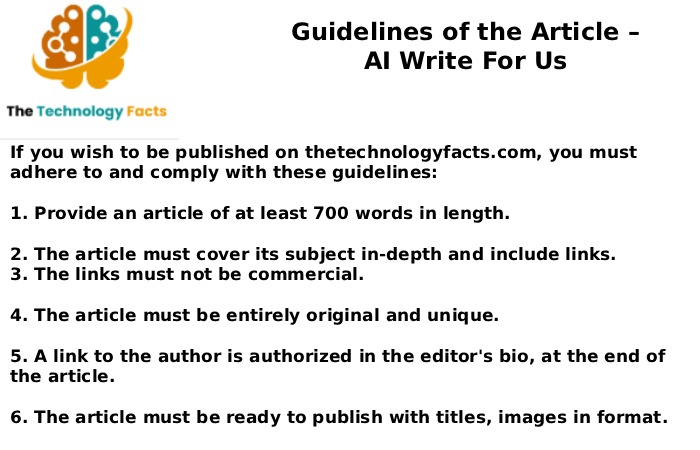
Guidelines of the Article – AI Write for Us
We can’t wait to hear from you! Send your writer’s pitch, a short bio, and a writing sample to contact@thetechnologyfacts.com